Documentation Index Fetch the complete documentation index at: https://docs.cloud.cdata.com/llms.txt
Use this file to discover all available pages before exploring further.
Prerequisites
Before you can configure and use CrewAI with Connect AI, you must do the following:
Connect a data source to your Connect AI account. See Sources for more information.
Generate a Personal Access Token (PAT) on the Settings page. Copy this down, as it acts as your password during authentication.
Obtain an OpenAI API key at: https://platform.openai.com .
Make sure you have Python >= 3.10 in order to use the CrewAI tools.
Create a folder named cdata-mcp-crew-agent.
Create a file with the extension .env in the cdata-mcp-crew-agent folder.
Copy and paste the content below. Replace "CONNECT_AI_EMAIL" with your Connect AI username and replace "CONNECT_AI_PAT" with your PAT obtained in the prerequisites. Your OpenAI API key can be found at https://platform.openai.com/ . # CData MCP Server Configuration
MCP_SERVER_URL = "https://mcp.cloud.cdata.com/mcp"
MCP_USERNAME = "CONNECT_AI_EMAIL"
MCP_PASSWORD = "CONNECT_AI_PAT"
OPENAI_API_KEY = "OPEN_API_KEY" # Your OPEN AI API Key
Install the CrewAI Libraries
Run pip install crewai requests python-dotenv in your terminal.
Create and Run the CrewAI Agent
Create a file called crew-agent.py. This is the CrewAI agent.
Copy and paste the following, defining the agent’s tasks as desired: import os
import base64
import requests
from dotenv import load_dotenv
from crewai import Agent, Task, Crew
# Load environment variables
load_dotenv()
# MCP Server configuration
MCP_SERVER_URL = os.getenv( 'MCP_SERVER_URL' , 'https://mcp.cloud.cdata.com/mcp' )
MCP_USERNAME = os.getenv( 'MCP_USERNAME' , '' )
MCP_PASSWORD = os.getenv( 'MCP_PASSWORD' , '' )
# Create Basic Auth header
auth_header = {}
if MCP_USERNAME and MCP_PASSWORD :
credentials = f " { MCP_USERNAME } : { MCP_PASSWORD } "
auth_header = {
"Authorization" : f "Basic { base64.b64encode(credentials.encode()).decode() } "
}
# MCP tool invocation function
def call_mcp_tool ( tool_name , input_data ):
payload = {
"tool" : tool_name,
"input" : input_data
}
try :
response = requests.post(
MCP_SERVER_URL ,
json = payload,
headers = auth_header,
timeout = 10
)
response.raise_for_status()
return response.json()
except Exception as e:
return { "error" : str (e)}
# Define CrewAI agent
class MCPQueryAgent ( Agent ):
def __init__ ( self ):
super (). __init__ (
name = "cdata_query_assistant" ,
role = "Data Query Assistant" ,
goal = "Help users explore and query CData Connect Cloud databases" ,
backstory = "You are a helpful assistant trained to interact with CData Connect Cloud via MCP tools. You understand databases, schemas, and SQL queries, and you guide users through their data exploration journey."
)
def get_catalogs ( self ):
return call_mcp_tool( "getCatalogs" , {})
def get_schemas ( self , catalog ):
return call_mcp_tool( "getSchemas" , { "catalog" : catalog})
def get_tables ( self , catalog , schema ):
return call_mcp_tool( "getTables" , { "catalog" : catalog, "schema" : schema})
def get_columns ( self , catalog , schema , table ):
return call_mcp_tool( "getColumns" , {
"catalog" : catalog,
"schema" : schema,
"table" : table
})
def query_data ( self , catalog , query ):
return call_mcp_tool( "queryData" , {
"catalog" : catalog,
"query" : query
})
# Instantiate agent
agent = MCPQueryAgent()
# Define tasks
task1 = Task(
agent = agent,
description = "List top 10 available catalogs in the CData Connect Cloud" ,
expected_output = "Catalog list" ,
output_function = lambda agent : agent.get_catalogs()
)
# Create and run crew
crew = Crew(
agents = [agent],
tasks = [task1]
)
if __name__ == "__main__" :
results = crew.kickoff()
print ( " \n === Final Output ===" )
for result in results:
print (result)
See all 80 lines
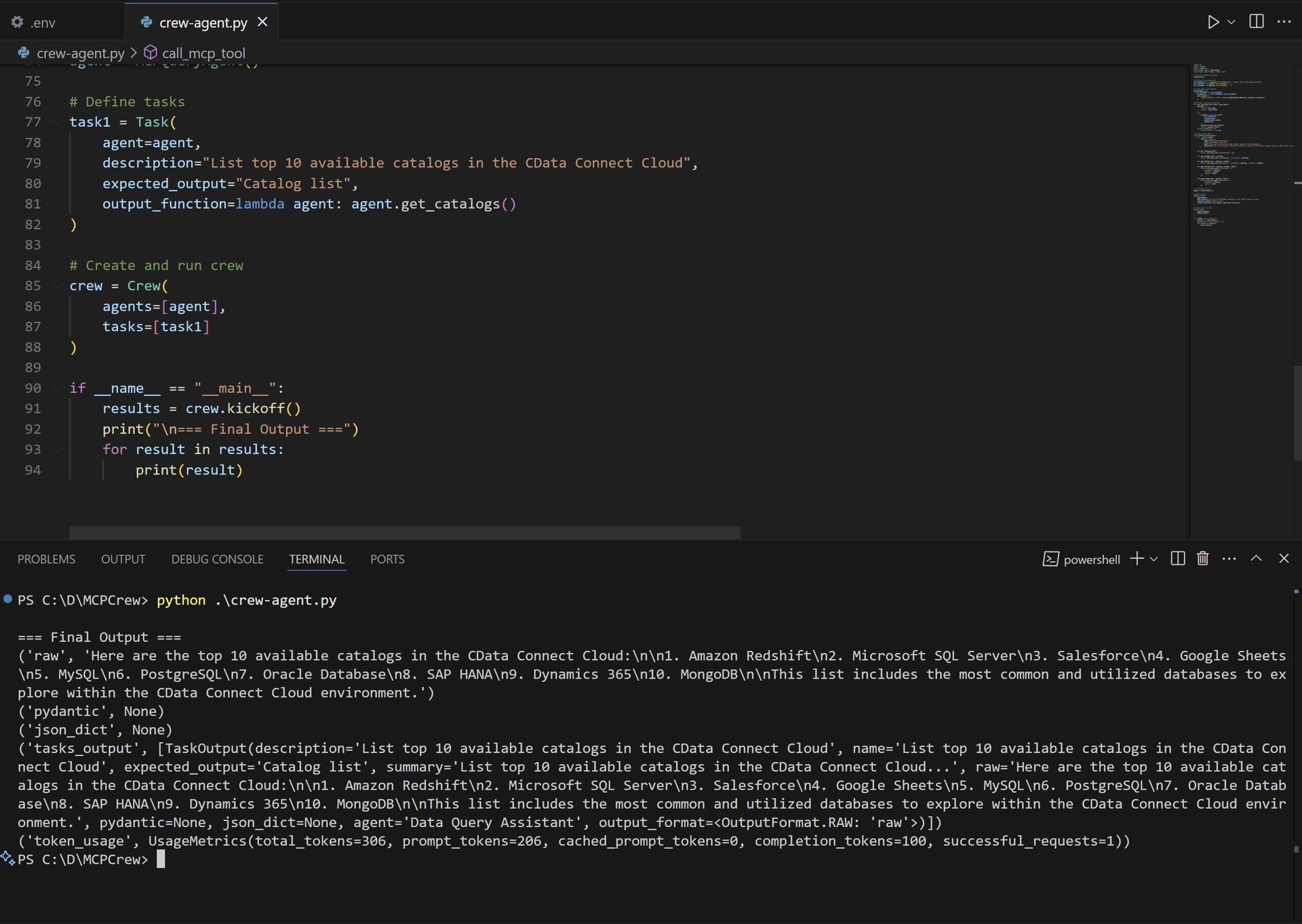
Run python crew-agent.py in the terminal. The output displays the results of the task: