

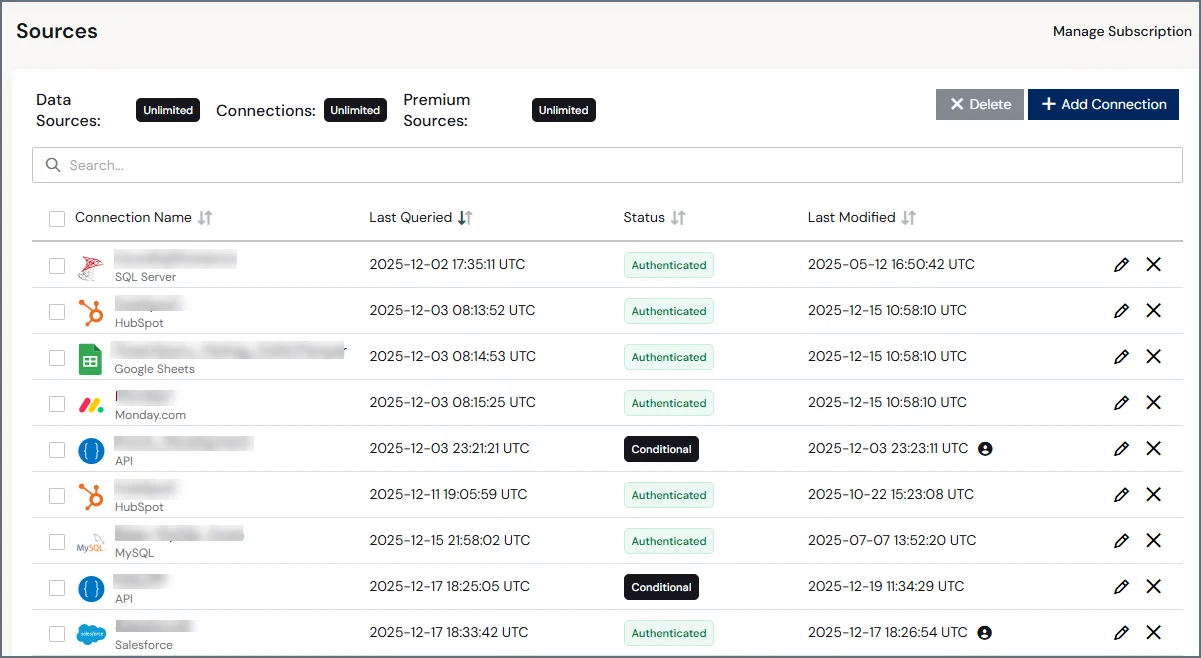
- Connection Name and Data Source—the user-defined name of the connection and the data source type of the connection. This column also contains an icon indicating that the data source supports custom reports.
- Last Queried—the last time a user queried the data.
- Status—The status of the connection, which can be one of the following:
- Authenticated—the connection to the data source is successful.
- Not Authenticated—the connection was created in Connect AI, but is not successfully connected to the data source. You can return to the connection’s edit screen to authenticate the connection. Note that Query users need to contact an administrator to authenticate a connection.
- Conditional—the connection is conditional based on the global settings and tables added to the connector. This occurs with the API connector.
- Last Modified—the date and time a user last modified the connection. Click the user icon next to the date and time to display the user who last modified the data.
Add a Connection
To add a new connection, complete the following steps:1
On the Sources page, click Add Connection. This action displays the Add Connection dialog.
2
Select a data source from the list in the dialog, or search for a connection by name.
1
Configure the connection according to the instructions for the data source. Setup instructions appear in the Documentation tab in the right pane of the configuration page. They are also available in this documentation—look for your data source in the Data Sources section, or use the search bar to find it.
2
Click Save and Test.
If you attempt to modify or delete a connection and Connect AI finds a cached job from the current connection, you are prompted with a warning. You can choose to cancel or continue with the changes. If you save the changes, Connect AI clears the cached data from the current connection.
Query users need to contact an administrator of the account to have a draft connection authenticated.
Authentication Model
By default, all users on an account can access data from a data source through the same login credentials. For example, if you have a connection to Salesforce, all user accounts can access the data from the Salesforce account created for that Salesforce connection. Query permissions can be customized for each user to restrict available operations, but all users access the same data under these restrictions. Certain data sources support the ability to force each user on an account to log in to a connection with their own login credentials. This feature ensures that users can only access the data from accounts that they need to access. Furthermore, when a connection is configured in this way, it only counts as a single connection slot toward your account maximum. If a data source supports per-user authentication, an Authentication Model section appears under the Authentication section of the connection settings. Select either Shared Authentication or Per-User Authentication.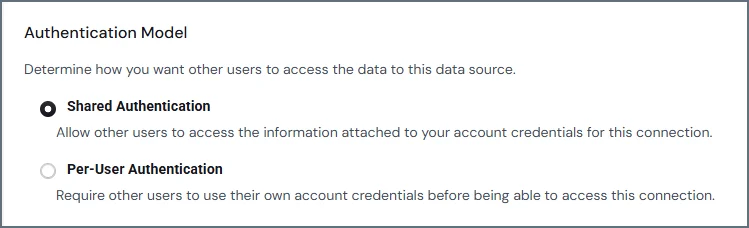
The following restrictions apply to this feature:
- Only administrator users can toggle a data source between shared authentication and per-user authentication, but users of all roles can log in to a per-user authentication connection with their own credentials.
- Per-user authentication is not supported when using the OData API. To connect a data source to the OData API, you must use shared authentication.
- Caching is not permitted with per-user authentication (only shared authentication). See Caching for details.
Log Verbosity
On the Advanced Settings tab for each connection, there is a setting in the Logging section labeled Verbosity. This value determines how much information Connect AI includes in the logs for that data source on the Logs page. The value for verbosity can range from 1 to 5, where 1 includes the smallest amount of information and 5 includes the largest amount of information. By default, each data source logs at verbosity level 2. Please note that higher verbosity levels negatively impact query performance. For maximum performance, be sure to only increase the verbosity level for troubleshooting purposes.Protecting Sensitive Information in Logs
Verbosity levels 3 and up include sensitive information from the connection, as outlined below:- Level 3 includes the bodies of requests and responses to requests.
- Level 4 includes SSL certificates.
- Level 5 includes extra low-level transfer data not included at the previous levels.
Regardless of the verbosity level, sensitive connection properties—including passwords—are always masked in connection strings and any requests/responses.
Assign Permissions
When you create or edit a connection, the Permissions tab displays a list of available users and allows you to assign permissions to each one. Permissions are described in the list below:- Select: Enables you to select rows from tables in a connection.
- Insert: Enables you to insert rows into tables of a connection.
- Update: Enables you to update rows in tables of a connection.
- Delete: Enables you to delete rows from tables in a connection.
- Execute: Enables users to execute stored procedures in a connection.
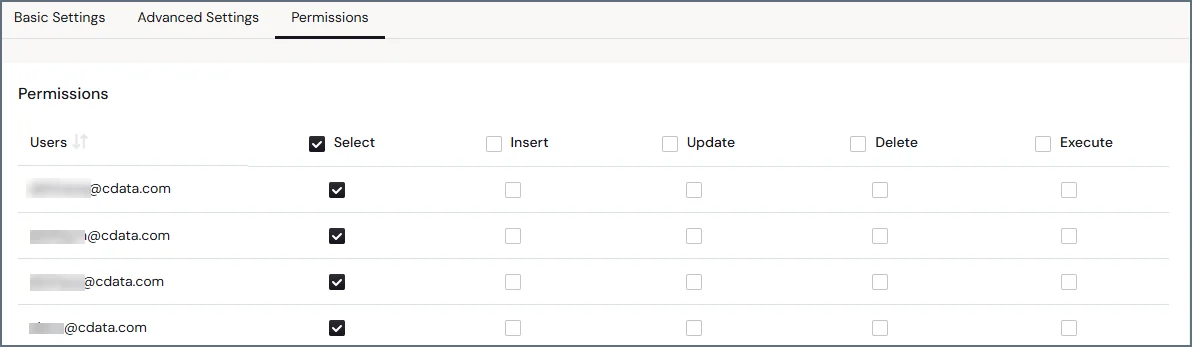
- Click an individual box in the table to toggle that permission for a single user.
- Click the box at the top of a table column to toggle that permission for every user.
Configure Custom Reports
Some data sources support custom reports, which allow you to configure pre-defined reports that you can query as views within your connections. Each report has a unique set of required inputs, and you provide these inputs when you configure the report in your Connect AI account. Custom reports are generally useful in two types of scenarios:- For ad or analytics data sources, they can be used to show aggregated reports on performance data by allowing you to pre-define a set of metrics and dimensions.
- Other types of data sources let you pre-define parameters to create data reports. For example, an accounting API might allow you to create a general ledger report in QuickBooks.
Create a Custom Report
If a data source supports custom reports, a Custom Reports tab appears on the connection settings page. Clicking this tab opens the custom reports interface, as shown below:
1
Click Add above the report table. A Configure Table dialog appears with a list of the custom reports available for your chosen data source.
2
In Step 1: Select Report, select the report you want to use and click Next.
3
In Step 2: Customize Report, set the parameters for the report, and then click Save Report to save the custom report to your account.
Custom reports are not shared across multiple connections to the same data source. For example, if you have two separate connections to Adobe Analytics, both connections will have their own lists of custom reports.
Use a Custom Report
You can query saved custom reports by passing the name of the custom report in the table field for your query. For example, if you have a custom report called Customer Accounts List on your QuickBooks Online connection, you could select all of its results with this query:Edit a Custom Report
To edit an existing custom report, follow these steps:1
In the report table, find the report you want to edit.
2
Click the report name or type, or click the edit button.
3
In Edit Custom Report, add or change report parameters.
4
Click Save Report.
Duplicate a Custom Report from an Existing Report
To duplicate an existing custom report, follow these steps:1
In the report table, find the report you want to duplicate.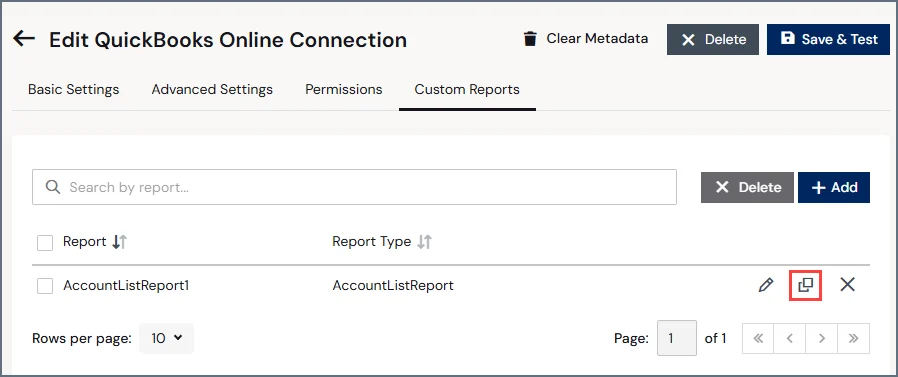
2
Click the duplicate button. Connect AI creates a duplicate custom report for the data source with a new name.
3
Edit the Report Name, if desired, and click Save Report.
Delete a Custom Report
To delete an existing custom report, follow these steps:1
In the report table, find the report you want to delete.
2
Click the delete button to the right of the report. Alternatively, you can select one or more reports on the Custom Reports tab and click Delete.
3
Click Delete again in the dialog to confirm.