メインコンテンツへスキップ

Prerequisites

Before you can configure and use CrewAI with Connect AI, you must do the following:
  • Connect a data source to your Connect AI account. See Sources for more information.
  • Settings ページでPersonal Access Token(PAT)を生成します。PAT をコピーし、認証時にパスワードとして使用します。
  • Obtain an OpenAI API key: https://platform.openai.com/.
  • Make sure you have Python >= 3.10 in order to use the CrewAI tools.

Configure the Connect AI MCP Server

1
Create a folder named cdata-mcp-crew-agent.
2
Create a file with the extension .env in the cdata-mcp-crew-agent folder.
3
Copy and paste the content below. Replace "CONNECT_AI_EMAIL" with your Connect AI username and replace "CONNECT_AI_PAT" with your PAT obtained in the prerequisites. Your OpenAI API key can be found at https://platform.openai.com/.
# CData MCP Server Configuration
MCP_SERVER_URL="https://mcp.cloud.cdata.com/mcp"
MCP_USERNAME="CONNECT_AI_EMAIL"
MCP_PASSWORD="CONNECT_AI_PAT"
OPENAI_API_KEY="OPEN_API_KEY"  # Your OPEN AI API Key

Install the CrewAI Libraries

Run pip install crewai requests python-dotenv in your terminal.

Create and Run the CrewAI Agent

1
Create a file called crew-agent.py. This is the CrewAI agent.
2
Copy and paste the following, defining the agent’s tasks as desired:
import os
 import base64
 import requests
 from dotenv import load_dotenv
 from crewai import Agent, Task, Crew
 # Load environment variables
 load_dotenv()
 # MCP Server configuration
 MCP_SERVER_URL = os.getenv('MCP_SERVER_URL', 'https://mcp.cloud.cdata.com/mcp')
 MCP_USERNAME = os.getenv('MCP_USERNAME', '')
 MCP_PASSWORD = os.getenv('MCP_PASSWORD', '')
 # Create Basic Auth header
 auth_header = {}
 if MCP_USERNAME and MCP_PASSWORD:
     credentials = f"{MCP_USERNAME}:{MCP_PASSWORD}"
     auth_header = {
         "Authorization": f"Basic {base64.b64encode(credentials.encode()).decode()}"
     }
 # MCP tool invocation function
 def call_mcp_tool(tool_name, input_data):
     payload = {
         "tool": tool_name,
         "input": input_data
     }
     try:
         response = requests.post(
             MCP_SERVER_URL,
             json=payload,
             headers=auth_header,
             timeout=10
         )
         response.raise_for_status()
         return response.json()
     except Exception as e:
         return {"error": str(e)}
 # Define CrewAI agent
 class MCPQueryAgent(Agent):
     def __init__(self):
         super().__init__(
             name="cdata_query_assistant",
             role="Data Query Assistant",
             goal="Help users explore and query CData Connect Cloud databases",
             backstory="You are a helpful assistant trained to interact with CData Connect Cloud via MCP tools. You understand databases, schemas, and SQL queries, and you guide users through their data exploration journey."
         )
     def get_catalogs(self):
         return call_mcp_tool("getCatalogs", {})
     def get_schemas(self, catalog):
         return call_mcp_tool("getSchemas", {"catalog": catalog})
     def get_tables(self, catalog, schema):
         return call_mcp_tool("getTables", {"catalog": catalog, "schema": schema})
     def get_columns(self, catalog, schema, table):
         return call_mcp_tool("getColumns", {
             "catalog": catalog,
             "schema": schema,
             "table": table
         })
     def query_data(self, catalog, query):
         return call_mcp_tool("queryData", {
             "catalog": catalog,
             "query": query
         })
 # Instantiate agent
 agent = MCPQueryAgent()
 # Define tasks
 task1 = Task(
     agent=agent,
     description="List top 10 available catalogs in the CData Connect Cloud",
     expected_output="Catalog list",
     output_function=lambda agent: agent.get_catalogs()
 )
 # Create and run crew
 crew = Crew(
     agents=[agent],
     tasks=[task1]
 )
 if __name__ == "__main__":
     results = crew.kickoff()
     print("\n=== Final Output ===")
     for result in results:
         print(result)
3
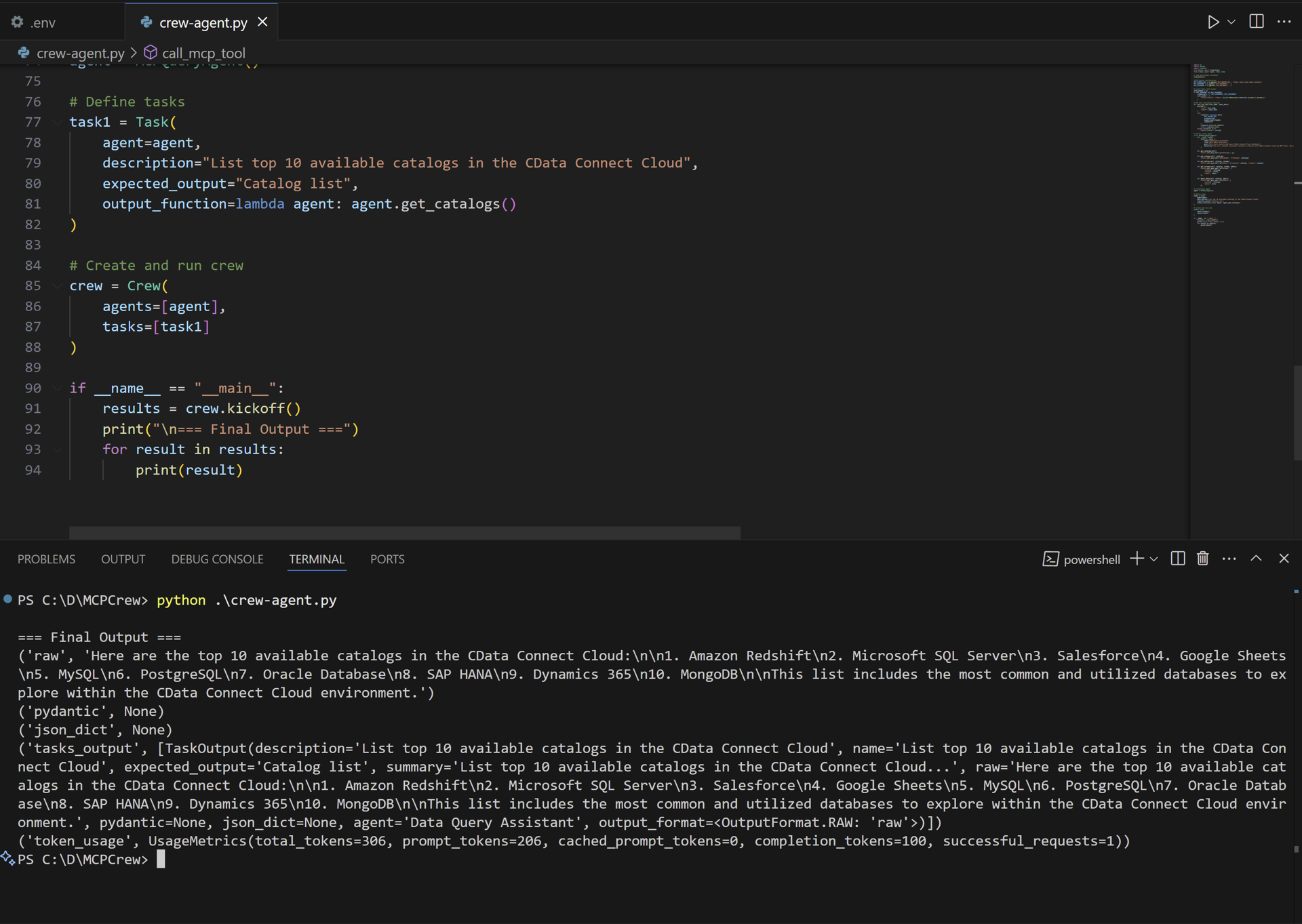
Run python crew-agent.py in the terminal. The output displays the results of the task:
CrewAI client output